The fractional quantum anomalous Hall effect (FQAHE), an exotic quantum state emerging at zero magnetic field and hosting fractionally charged excitations, has found a promising platform in moiré superlattices formed by multilayer rhombohedral graphene and boron nitride. A key factor in realizing this state is the modulation of flat electronic bands by the moiré periodic potential. In a recent study, Professor Shuyun Zhou from the Department of Physics at Tsinghua University, together with collaborators, reported the first direct observation of topological flat bands and their moiré replicas in a five-layer rhombohedral graphene/boron nitride heterostructure. Their experiments further revealed a pronounced enhancement of the flat bands induced by the moiré potential, shedding new light on the underlying electronic mechanisms. The study, titled "Moiré enhanced flat band in rhombohedral graphene," has been published in Nature Materials.
Rhombohedral graphite is known for its rich electronic properties. Previous work by Zhou’s team identified bulk rhombohedral graphite as a topological nodal-line semimetal with topological protected correlated flat bands (PNAS 121, e2410714121 (2024)). In their latest work, the researchers explored the electronic structure of a five-layer rhombohedral graphene/boron nitride heterostructure - a system known to exhibit the FQAHE. In such structures, fractional states typically occur when the graphene and boron nitride layers are close to perfect alignment, yielding a moiré period larger than 10 nm. This suggests the moiré potential plays an essential role. Yet, the FQAHE tends to emerge away from the moiré interface side, raising a fundamental question: how does the moiré potential influence electronic states remotely?
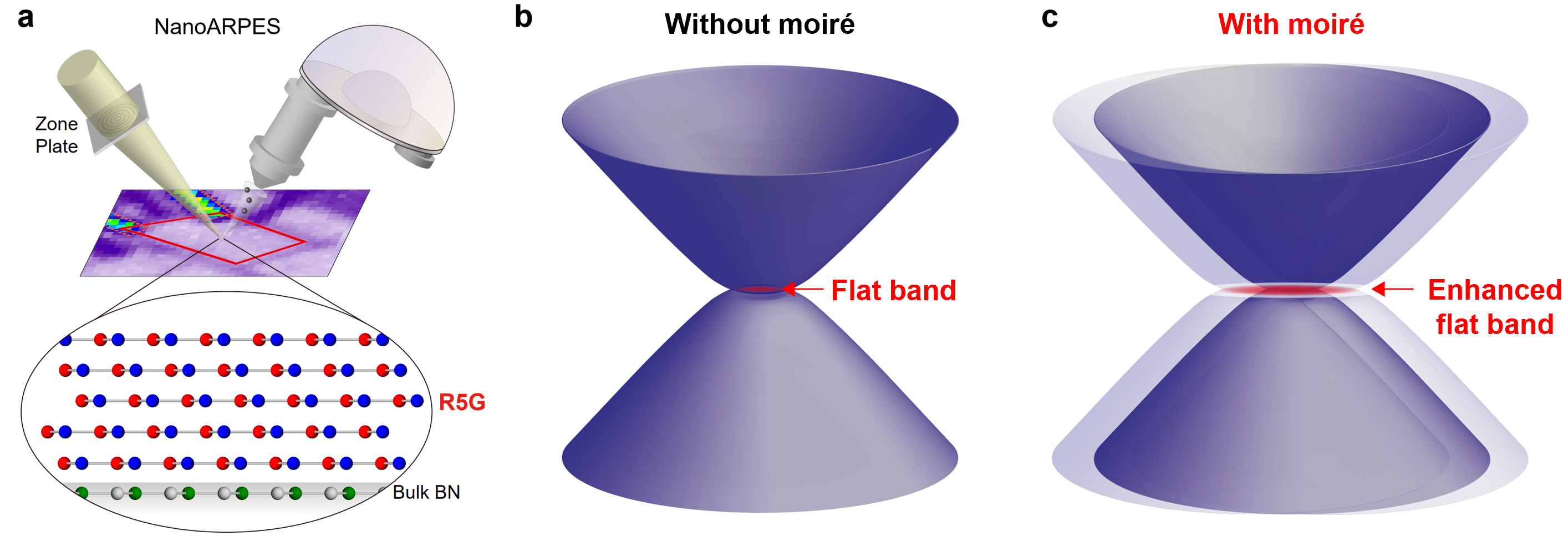
Figure 1: Electronic structure of moiré-enhanced flat bands in rhombohedral graphene. (a) Schematic of the experimental setup using nanospot angle-resolved photoemission spectroscopy (NanoARPES) and the five-layer rhombohedral graphene/boron nitride heterostructure. (b) Electronic structure of five-layer rhombohedral graphene in the absence of a moiré potential. (c) Electronic structure under moiré potential modulation. The red arrow highlights the markedly enhanced flat band.
To resolve this puzzle, the research team employed NanoARPES (Fig. 1a), a technique capable of probing electronic structures with sub-100-nm spatial resolution. They directly imaged the topological flat bands in the heterostructure and extracted key parameters related to interlayer electron hopping. The data revealed a strong enhancement of the flat band signal in the presence of the moiré potential. Notably, well-defined moiré replica bands were detected even in graphene layers located far from the moiré interface (Fig. 2b), indicating that the moiré potential’s influence extends well beyond the interface region.
Theoretical simulations provided further insight: although the moiré potential is spatially confined near the interface, interlayer electron-electron interactions in rhombohedral graphene mediate its effect, effectively “transmitting” the potential-induced charge modulation to remote layers. This non-local interaction significantly modifies the topological flat band electronic structure in regions distant from the interface, offering a plausible explanation for the stability of the FQAHE in these layers. The results highlight both the real-space non-locality of the moiré potential and the essential role of electron correlations in propagating topological effects, providing key experimental and theoretical support for understanding correlated quantum phenomena in rhombohedral graphene.
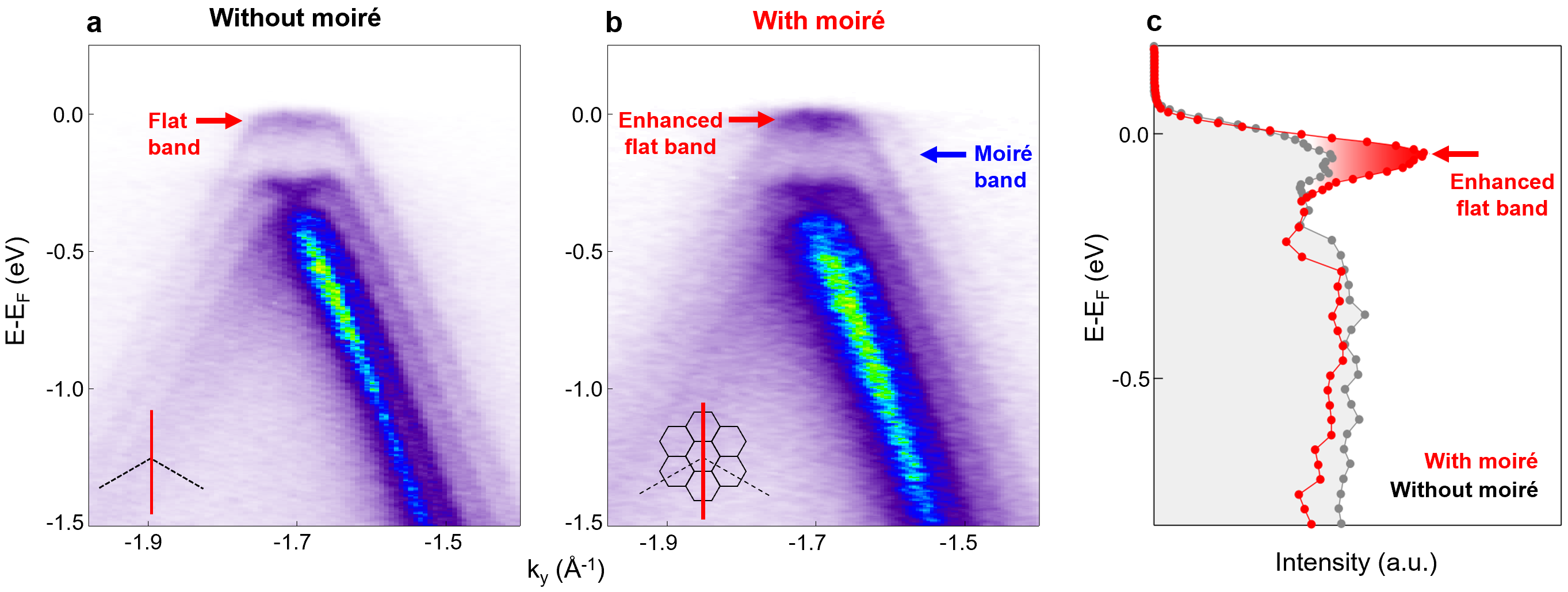
Figure 2: Moiré-enhanced flat band in a five-layer rhombohedral graphene heterostructure. (a) Experimental electronic structure without a moiré potential. (b) Electronic structure under moiré modulation. The red arrow marks the strongly enhanced flat band; blue arrows indicate moiré replica bands. (c) Energy distribution curves near the flat band region, comparing the signal intensity with and without the moiré potential. The red arrow highlights the enhanced spectral weight in the presence of the moiré.
Professor Shuyun Zhou (Tsinghua University), Guorui Chen (Shanghai Jiao Tong University), and Zhida Song (Peking University) are corresponding authors of this study. Co-first authors included Dr. Hongyun Zhang (former Tsinghua "Shuimu Scholar," now at Beijing Tsinghua Institute for Frontier Interdisciplinary Innovation), Ph.D. candidates Jinxi Lu (Tsinghua University), Kai Liu (Shanghai Jiao Tong University), and Yijie Wang (Peking University). The collaborative team also involved Professor Wenhui Duan and Pu Yu (Tsinghua University), Professor Takafumi Sato (Tohoku University, Japan), and researchers from SOLEIL in France and Diamond Light Source in the UK. The research received support from the National Key R&D Program of China, the Tsinghua University Initiative Scientific Research Program, the New Cornerstone Science Foundation through the XPLORER PRIZE, and the National Natural Science Foundation of China.
Paper link: https://doi.org/10.1038/s41563-025-02416-2