A research team led by Associate Professor Ding Shiqian from Tsinghua University's Department of Physics has successfully demonstrated an operational thorium-229 (²²⁹Th) nuclear clock, marking a major milestone in precision timekeeping. By using transitions within atomic nuclei rather than electrons to stabilize a laser's frequency, the team has helped bring a decades-old scientific concept into reality.
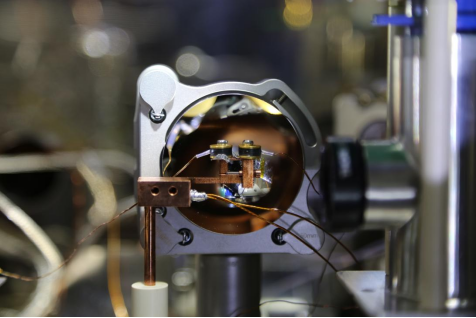
Part of an experimental nuclear optical clock
The achievement was reported in a paper titled “A nuclear clock synchronized to ²²⁹Th,” published online in Nature on October 7. The study was conducted by researchers from Tsinghua University, and several partner institutions.
Unlike conventional atomic clocks, which use energy transitions in electrons as their frequency reference, a nuclear clock relies on a transition within an atomic nucleus. Because an atomic nucleus is much smaller, nuclear transitions are less susceptible to external electromagnetic disturbances than electron transitions. Therefore, nuclear clocks could eventually provide highly stable and precise frequency references.
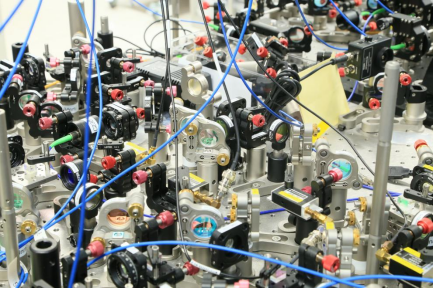
A set-up with mirrors, lenses and cables arranged on a table, used for a nuclear clock experiment
The ²²⁹Th isotope is particularly promising because it has a uniquely low-lying, laser-accessible isomeric nuclear transition in the vacuum-ultraviolet range. More than two decades ago, scientists proposed using this transition to construct a nuclear clock. However, realizing such a clock has long required overcoming several major challenges, including the lack of a suitable continuous-wave laser, the extreme scarcity of ²²⁹Th, and the difficulty of producing high-quality nuclear-clock crystals.
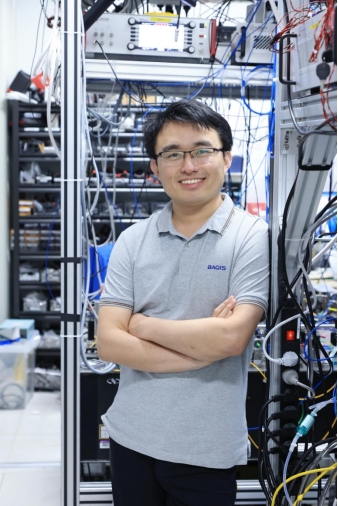
Ding Shiqian
Ding began pursuing the thorium-229 nuclear clock after joining Tsinghua University in December 2021, when no established technical approach was available. Over the following years, his team developed a narrow-linewidth, continuous-wave vacuum-ultraviolet (VUV) laser operating at 148.4 nanometers, overcoming one of the central obstacles to building a nuclear clock. The laser breakthrough was separately reported in Nature in February 2026.
The laser source generates approximately 10 microwatts of continuous-wave VUV radiation, with an estimated sub-hertz linewidth. The team combined this traceable VUV probe with ²²⁹Th: CaF₂ crystals and phototube-based frequency-modulation absorption spectroscopy. This system provided a high-signal-to-noise nuclear frequency discriminator, allowing the researchers to stabilize the VUV laser to a resolved, weakly temperature-sensitive nuclear transition and close a feedback loop to the transition known as line b.
This enabled the team to demonstrate the operation of a ²²⁹Th nuclear clock. The clock achieved a fractional frequency instability of 5 × 10⁻¹³/√(τ/s), where τ is the averaging time. Clock-transition frequencies measured in two independently fabricated crystals agreed at the 10⁻¹³ level and were consistent with previous VUV-frequency-comb measurements performed on other ²²⁹Th: CaF₂ crystals. These results establish laser-addressed nuclei as operational clock references and provide a reproducible solid-state platform for compact nuclear clocks.
The preparation of the nuclear-clock crystal presented a significant challenge. Working with collaborators from the Shanghai Institute of Ceramics, the Shanghai Institute of Optics and Fine Mechanics, and the Shanghai Institute of Applied Physics of the Chinese Academy of Sciences, the team fabricated a compact, high-quality ²²⁹Th: CaF₂ crystal in a single growth run from a solution containing only 1.4 micrograms of ²²⁹Th, equivalent to 10 kilobecquerels.
This milestone breakthrough could not have been achieved without extensive collaboration. The team led by Zhang Xibo at Peking University and the team led by Lin Yige at the National Institute of Metrology, China, provided important technical support in ultrastable lasers, frequency metrology, and precision measurement. Professors Mo Yuxiang and You Li from Tsinghua’s Department of Physics contributed their extensive experience in four-wave mixing, optical frequency combs, and related experimental designs. The team led by Liu Xuegang at Tsinghua’s Institute of Nuclear and New Energy Technology provided essential support for the preparation and characterization of thorium-doped crystals, as well as for experimental work involving ²²⁹Th. Tsinghua University and the Beijing Academy of Quantum Information Sciences provided comprehensive support throughout the project, from its launch through the most demanding stages of the research.
The significance of the work extends beyond the development of a more precise clock. Today’s most advanced optical atomic clocks are extraordinarily accurate but remain complex laboratory systems. A solid-state nuclear clock could eventually be made more compact, robust and easier to operate, creating new possibilities for navigation, space-based measurements, telecommunications and precision synchronization.
The ²²⁹Th nuclear transition may also be particularly sensitive to possible changes in fundamental constants. Comparisons between nuclear clocks and atomic clocks could therefore provide a new way to test fundamental physical laws and search for signals of dark matter. The successful operation of the clock also represents an important step toward quantum control at the scale of the atomic nucleus.
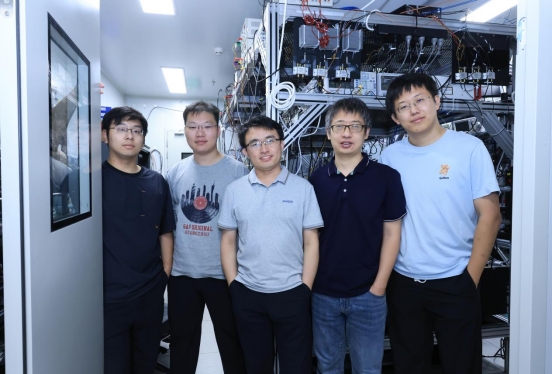
Ding Shiqian and his team
The Tsinghua team will continue working to improve the clock’s accuracy and stability and to develop more compact and practical devices. The researchers are also exploring an ion-trap nuclear clock, with the goal of achieving more direct control of nuclear quantum states.
By bringing laser precision measurement from the electronic shell into the atomic nucleus, the team’s work opens a new path for both precision timekeeping and fundamental physics. It also demonstrates how coordinated efforts across institutions can turn a long-standing scientific vision into an operational technology.